






Forex scalping is often associated with fast charts, rapid decisions, and multiple trades opened within a single trading session. For some traders, the appeal is obvious: instead of waiting days or weeks for a position to develop, scalpers attempt to capture relatively small price movements within minutes or even seconds.
But speed does not have to mean recklessness.
In fact, a disciplined approach can make scalping considerably more structured. A low-risk forex scalping strategy focuses less on taking as many trades as possible and more on controlling the amount that can be lost when a setup fails. Tight stop-loss orders, carefully selected entry points, appropriate position sizing, and strict risk limits all play an important role.
Of course, no forex strategy is genuinely risk-free. Scalping carries significant risks, including spreads, slippage, market volatility, and rapid losses. The goal is therefore not to eliminate risk, but to keep potential losses controlled and avoid allowing one bad trade to damage the trading account.
What Is Forex Scalping?
Forex scalping is a short-term trading style in which traders attempt to profit from relatively small price movements.
A scalper might hold a position for:
- Several seconds
- A few minutes
- 15–30 minutes
- Occasionally longer, depending on the strategy
Instead of targeting a large movement, the trader may look for a smaller opportunity repeated across several carefully selected setups.
For example, a trader analyzing EUR/USD might identify a short-term breakout and attempt to capture a 5–10 pip movement.
The challenge is that small targets also mean that transaction costs matter more. A strategy that appears profitable before costs can become much less attractive once spreads, commissions, and slippage are considered.
This is why risk control is particularly important for scalpers.

What Makes a Low-Risk Forex Scalping Strategy Different?
A low-risk forex scalping strategy isn’t simply a strategy with a very tight stop-loss.
A genuinely risk-conscious approach combines several elements:
High-quality setups + controlled position size + predefined stop-loss + realistic profit target + strict daily risk limits
The idea is simple: you don’t need every trade to be profitable. You need your losses to remain manageable when you’re wrong.
For example, imagine a trader risks 0.5% of their account on each trade.
Even after several losing trades, the account remains relatively protected compared with a strategy that risks 3–5% every time.
This approach also helps reduce emotional pressure. When traders know exactly how much they can lose before entering a position, they are less likely to move their stop-loss or increase their position size impulsively.
Why Tight Stop Losses Matter in Scalping
A stop-loss automatically closes a trade when the market reaches a predetermined level.
For scalpers, stop-losses are particularly important because short-term markets can change direction very quickly.
Suppose a trader enters EUR/USD at:
1.1750
They place a stop-loss at:
1.1745
The trade has a 5-pip stop.
If the setup fails and price reaches 1.1745, the position is closed rather than allowing a small losing trade to become a much larger one.
However, there is an important distinction between a tight stop and an arbitrarily small stop.
A stop-loss should generally be placed where the original trading idea becomes invalid—not simply as close to the entry as possible.
A stop that is too tight can be triggered by normal market noise before the anticipated move occurs.
The Foundation: Risk Per Trade
One of the most useful principles in a low-risk forex scalping strategy is establishing a maximum percentage of account equity that can be lost on a single trade.
Many traders choose a relatively small percentage, such as:
0.25%–1% per trade
The appropriate amount depends on the trader’s strategy, experience, account size, and risk tolerance.
For example, with a $10,000 trading account:
- 0.25% risk = $25
- 0.5% risk = $50
- 1% risk = $100
If the trader decides to risk 0.5%, their maximum planned loss is $50.
The next question becomes: How large should the position be?
This is where position sizing becomes more important than simply choosing a lot size.
Position Size Should Follow the Stop Loss
A common beginner mistake is choosing a position size first and then deciding where to put the stop.
A more disciplined approach works in the opposite direction.
Step 1: Determine how much you are willing to risk.
Step 2: Identify the logical stop-loss level.
Step 3: Calculate the distance between entry and stop.
Step 4: Adjust the position size so that the potential loss remains within your predetermined risk limit.
For example, suppose your account is $5,000 and you decide to risk 0.5%.
Your maximum risk is:
$5,000 × 0.005 = $25
If the technical setup requires a 5-pip stop, your position size needs to be calculated so that a 5-pip loss does not exceed approximately $25.
This approach creates consistency.
You don’t widen the stop simply because your position is too large. Instead, you reduce the position size.
A Simple Low-Risk Forex Scalping Strategy
Let’s build a straightforward example that combines several risk-control principles.
Step 1: Choose a Liquid Currency Pair
Scalpers generally benefit from focusing on highly liquid instruments with competitive spreads.
Major pairs such as EUR/USD, GBP/USD, and USD/JPY are commonly used by short-term traders.
Avoid jumping between dozens of pairs. Focusing on a small watchlist can make it easier to recognize recurring price behavior.
Step 2: Choose a Short-Term Time Frame
Scalpers often use charts such as:
- 1-minute
- 5-minute
- 15-minute
However, lower time frames contain considerable market noise.
One practical approach is to use a higher time frame for context and a lower time frame for execution.
For example:
15-minute chart → identify trend and key levels
5-minute chart → identify entry
This can help prevent entering trades based purely on random fluctuations.
Step 3: Identify the Market Direction
Before entering, ask a simple question:
Is the market trending, ranging, or behaving erratically?
A scalping setup can be much easier to interpret when the broader short-term direction is clear.
For instance, if EUR/USD is consistently creating higher highs and higher lows on the 15-minute chart, a trader may focus primarily on potential long setups rather than constantly switching between buy and sell signals.
Step 4: Wait for a Pullback
Instead of chasing a strong price movement, the trader can wait for a temporary retracement toward a previously identified support or resistance area.
This can provide a more structured entry.
Imagine EUR/USD is trending upward and reaches 1.1800 before pulling back toward 1.1785.
Rather than buying at the peak of the initial movement, the trader waits to see whether buyers return around the relevant support zone.
Step 5: Look for Confirmation
A setup shouldn’t automatically become a trade.
Possible confirmation signals include:
- A bullish or bearish rejection candle
- Breakout and retest
- Moving-average alignment
- Momentum confirmation
- Support or resistance reaction
- A change in short-term market structure
The exact combination depends on the strategy.
The key principle is to avoid entering simply because the price “looks cheap” or “looks expensive.”
Step 6: Place the Stop Loss
Once the entry is identified, determine where the trade idea becomes invalid.
For a long trade, the stop could be placed below a relevant swing low.
For a short trade, it could be placed above a relevant swing high.
The stop should be close enough to control risk but far enough away to account for normal market fluctuations.
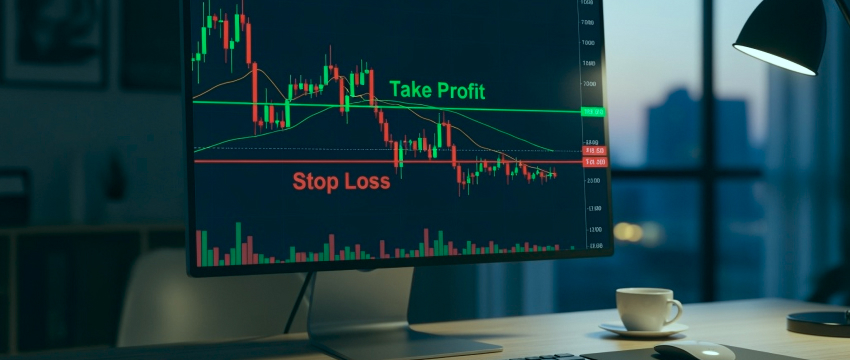
Step 7: Define the Profit Target
Scalping often involves relatively modest targets.
Suppose your setup has:
Entry: 1.1800
Stop: 1.1795
Target: 1.1810
The potential risk is 5 pips, while the potential reward is 10 pips.
That represents a:
1:2 risk-to-reward ratio
Not every scalping strategy needs a 1:2 ratio, but having a predefined relationship between potential risk and reward can help prevent random exits.
Don’t Ignore the Spread
One of the biggest differences between scalping and longer-term trading is the impact of transaction costs.
Imagine your strategy is designed to capture 5 pips.
If the spread consumes 1.5 pips, a significant portion of the expected movement has already been absorbed by trading costs.
This means a scalper should pay close attention to:
Spread + commission + slippage
A setup isn’t attractive simply because the chart suggests a profitable movement. The potential reward needs to make sense after costs are considered.
When Should You Avoid Scalping?
Sometimes the smartest trade is no trade.
A low-risk forex scalping strategy should include conditions under which the trader stays out of the market.
These can include:
- Extremely wide spreads
- Unusually high volatility
- Major economic announcements
- Poor liquidity
- Choppy price action
- Lack of a clear trend or structure
- Multiple consecutive losses
Major economic releases can cause prices to move dramatically within seconds. Even a carefully positioned stop-loss may experience slippage during extremely volatile conditions.
Therefore, traders should know when market conditions don’t suit their strategy.
Daily Loss Limits Can Protect Your Account
Risk management shouldn’t stop at individual trades.
A trader can also establish a maximum daily loss.
For example:
Maximum risk per trade: 0.5%
Maximum daily loss: 2%
Once the daily limit is reached, trading stops.
This rule can be surprisingly powerful because it prevents one of the most damaging habits in short-term trading: revenge trading.
After losing several trades, a trader may feel compelled to immediately recover the money. They increase their position size, abandon their strategy, and take lower-quality setups.
A daily loss limit creates a hard boundary.
The market will still be there tomorrow.
The Psychology Behind Low-Risk Scalping
Technical analysis may determine when to enter a trade, but psychology often determines whether a trader can follow their strategy consistently.
Scalping requires:
- Patience
- Discipline
- Fast decision-making
- Emotional control
- Consistent position sizing
- The ability to accept losses
One of the biggest misconceptions is that successful scalpers must constantly trade.
They don’t.
A disciplined scalper may spend much of a session waiting.
The goal isn’t to capture every movement. It’s to participate only when the conditions match the trading plan.
Common Mistakes to Avoid
Even a well-designed Low-Risk Forex Scalping Strategy can fail if risk management is ignored.
Using Excessive Leverage
High leverage can magnify both gains and losses. A small market movement can have a disproportionately large effect on an overleveraged account.
Moving the Stop Loss
Moving a stop farther away simply because the trade is losing defeats its purpose.
If the original setup is invalidated, accepting the loss is often more disciplined than hoping for a reversal.
Overtrading
More trades don’t necessarily mean more profit.
Taking ten mediocre setups is not automatically better than taking two high-quality opportunities.
Ignoring Trading Costs
Scalpers operate on small price movements, so spreads and commissions can significantly affect performance.
Increasing Risk After a Loss
A losing trade doesn’t mean the next trade has to be larger.
Maintain consistent risk rather than attempting to immediately recover losses.
How to Improve a Low-Risk Forex Scalping Strategy
The best way to refine a scalping strategy isn’t by constantly adding indicators.
Instead, keep detailed records.
For every trade, consider recording:
- Currency pair
- Entry price
- Stop-loss
- Take-profit
- Position size
- Time of entry
- Market conditions
- Reason for entering
- Result
- Screenshot of the setup
After collecting enough trades, look for patterns.
Perhaps your strategy performs better during specific market sessions. Maybe certain currency pairs produce better results. You may discover that trades taken during extremely volatile periods consistently perform poorly.
This turns trading from guesswork into a process that can be measured and improved.
Final Thoughts: Building a More Disciplined Scalping Approach
A low-risk forex scalping strategy isn’t about finding a magical indicator that predicts every short-term price movement.
It’s about creating a framework where individual losses remain manageable and no single trade can seriously damage your account.
Tight but technically justified stop-losses, controlled position sizing, realistic profit targets, awareness of trading costs, and strict daily risk limits can form the foundation of a disciplined scalping plan.
Most importantly, remember that low-risk does not mean risk-free. Forex markets can move unexpectedly, and execution conditions can change rapidly.
The objective is not to win every trade. It’s to make sure that when the market proves you wrong, the loss is small enough that you can step away, reassess, and return for the next opportunity.
In scalping, patience may seem contradictory to speed—but it is often the difference between simply trading frequently and trading with a plan